Tuesday, October 9, 2007

Getting Outfitted and Ready for Departure

Fifty people, dragging heavy suitcases, dufflebags and backpacks into the Clothing Distribution Center (CDC). The time for departure is nearing. It is time to receive the Extreme Cold Weather (ECW) clothing which will be our main attire down on the ice. Will it fit? Will it be warm enough? Will I be able to pick up the suitcase? Can I somehow consolidate the 30 plus pounds of ECW with my already voluminous piles of clothes, gear, electronics, and toiletries, to weigh in at under 75 pounds – the absolute weight allowance?

Marlene, a slight woman with a strong kiwi accent, briefs us on the process.
Which bags get checked. Which bags may be carry-ons. What items must go in our Boomerang bags… BOOMERANG BAGS? What’s that?

Flights from Christchurch to Antarctica often do not make it all the way to the continent on their first try. Sometimes they make it half way and need to turn back because bad weather has moved into McMurdo and they are unable to land, so they turn around. Sometimes there is aircraft trouble, so they turn around. Sometimes they get to 10 feet off the landing strip in McMurdo, and the conditions are unsuitable, so they turn back. Any of these scenarios will send the aircraft back to New Zealand. They are boomeranged.

Antarctic bound travelers, once they check their bags, are unable to get back at them until they are on the ice. So, we are now asked to pack boomerang bags – with clothing, a toothbrush, and whatever other necessities we may need for town life if our fight is boomeranged. The record number of times anyone has been boomeranged is 7! Can you imagine that?

When Marlene is done briefing us, we watch a video about the clothing distribution and flight protocols. We then go and deliver our computers to the Technology Screening Division to make sure that we are virus-free when we head to the ice. We leave it in the hands of the IT man, hoping it is there when we return.

We then proceed to a changing room, separated for women and men.
There are already 2 duffle bags packed for us, and a clothing list with our name on it is waiting for us. They are unbelievably organized! We begin the long process of trying on every item and checking zippers, Velcro, sizes, comfort… Whatever doesn’t fit is brought back to a window, sort of like the type of window at a concession stand where you order hot dogs and ice cream sandwiches when you are out at the beach for the day. But this window opens up to a vast warehouse of ECW clothing in all shapes, sizes and conditions. I want the best! I will be on the ice, in a tent, with sea water splashing on me, for 5 to 6 weeks! Now is the time to use all of that assertiveness training my mother taught me!

I try on the long underwear, the parka, the boots, the gloves, the socks, the goggles… The list goes on and on. I make a suitable pest of myself at the hotdog stand exchange window, but they are too kind to show their irritation with me. On my final item, the dear woman finally gave me 5 hats and said, in her lovely kiwi accent “look, there – just take the lot of these, and take your time with it. Find the one that suits you best, and bring me back the rest. Right? Cheers.”

Cheers. I did what I was told and, with the help of the kind ladies at the hotdog counter, I was fully equipped a mere 3 hours later. I packed everything up, separated the extra clothing and gear I would not be needing on the ice, and weighed in at a mere 69 pounds! Heck – I could go out and buy some chocolate to take with me – six pounds worth!!!

I took the shuttle back to my hotel, comparing notes with the others going through the same process. I continued to add to the list of people I was meeting who were headed down to the ice. It is absolutely amazing how many people go, and what their different functions are!

Plummers, cooks, dining room workers, engineers, architects, scientists studying the aging process of Weddell Seals, atmospheric chemists studying the ozone hole, people studying natural antifreeze in Antarctic Cod, Penguin researchers, geologists, geophysicists, geochemists, meteorologists, satellite researchers, helicopter mechanics, pilots, bar tenders, recreation coordinators, survival school teachers, mountaineer guides… An incredible array of people coming down to the ice! And everyone has stories to share with the rookies in the crowd!

It is time for my last walk in the garden, to take in the sights, smells, and sounds of spring before my trip south. It is a glorious day. Magnolias, camellias, daffodils are in full bloom. Baby ducks are swimming wildly to keep up with their elders. Birds are singing everywhere, rejoicing the spring. I take a deep breath, trying to store all of this deep inside of me to sustain me for the next two months.


Then I head off to dinner, enjoy a last kiwi meal with my full team. The manifest for tomorrow’s departure has been posted. One plane, the C-17 – a big, comfortable, fast plane – is “broken.” Two of us, Julia and I, will be flying out on a different aircraft at 9 am. This will be a Hercules – LC-130, also known as a “Herc.” A Herc is a slower plane, a turbo-prop (has propellers and jets), and has no “seats.” Rather, it has nylon webbing to sit on. Many are equipped with skis for landing on the ice shelf, and those skis do not retract – so it is a much longer flight than the other aircraft.

People groan when they hear that some of us are going on the Herc, and others get to ride in the yet-to-be-fixed C-17. As for me, I just want to get there already! And I would rather NOT be the first one out on a newly repaired plane!!

I must be ready for the shuttle at 5:25 am. The very dear hotel keeper gives me an alarm clock and explains this to me very carefully:

“I have called the shuttle for you, and it will come at 5:30, but be ready at 5:25.”

“I will be delivering a breakfast in a sack for you to eat, since the dining room will not be open yet. If you are not there when I deliver it, I will leave it in your room.”

“Here is an alarmclock and I am setting it for you for 5:00 am.”

“If there is a delay, they will call me and I will come and knock on your door. If you don’t answer, I will unlock your door and ask you to sit up and turn the light on, so I know you are awake and hearing me. And then I will give you the update, and tell you go to back to sleep.”

“When you leave, please leave your key in the door. If the plane doesn’t go, or if you are boomeranged, come on back and go back to sleep. We will not give your room to anyone else until we know that you have made it to the ice.”

“Try not to wake anyone else when you get up in the morning.”

It is AMAZING! The hotel keepers inform us of everything, they post the manifests for us and make us sign it, so that they know who to track down. They do everything with warmth and a smile and a “no worries, mate” attitude. AND… the rooms are nicely appointed and breakfasts are WONDERFUL!

With this very nice safety net around me, I went calmly to bed with my alarm clock ticking beside me.

At 5:00 am, I got up, showered, was just getting on my backpack – and the nice hotel keeper came walking up in his bathrobe saying, “Go back to bed. There is a 3 hour delay. The shuttle will be here for you at 8:30.”

He checked off my name, confirming that he had conveyed the message to me, and said,”I’ll see you at breakfast.”

Unbelievable.

Of course, I couldn’t go back to sleep. I was far too excited for sleep.

flying to McMurdo in cargo class


After spending a very pleasant spring week in New Zealand, Robin and I finally arrived at the USAP to change into our ECW gear and stuff all of our belongings into orange canvas bags, which hopefully when fully packed weighed 75 lbs. or less. We had woken up that morning about 4:45 to be ready for the shuttle bus at 5:30 to get us to the USAP by our 6:00 report time to get the 9:00 plane. But just as I was putting putting my toothbrush into my bag there was a knock on the door and the very nice man that runs the Windsor Bed and Breakfast was there to let me know there was a three hour delay, the shuttle would arrive now at 8:30 to get us on our way. Oh well, back to bed for a couple more hours of sleep.

So arriving at the USAP we changed into our gear designed to keep us warm in sub-zero temperatures on a sunny afternoon that was probably in the 60's. Too bad they didn't have a freezer for us to wait in. After an hour and a half of waiting we finally loaded onto the Hercules C-130. According to Wikipedia, the C-130 Hercules manufactured by Lockheed Corporation, is a four-engine turboprop cargo plane and the main tactical airlifter for many military forces worldwide. On December 2006 the C-130 reached the mark of 50 years of continuous use with its original primary customer (in this case the United States Air Force). The "Kiwi Herc" we boarded is in the service of the New Zealand Air Force. The C-130 is capable of short takeoffs and landings from unprepared runways and seems to be a reliable aircraft for transporting large amounts of cargo to Antarctica, in this case - people and luggage!

Instead of regular airline seats, we flew in relative comfort on benches made of canvas with cargo strapping seat backs. Yes, we had seatbelts, but no inflight entertainment. The engines were quite loud so everyone stuffed earplugs into their ears, which made it a little difficult to have any sort of conversation with each other. It was a rather long flight from Christ Church, New Zealand to McMurdo Station, about seven hours, but the last couple of hours were incredibly exciting once we spotted the frozen Antarctic continent underneath us. The mountain peaks and the varying patterns of ice and snow were breathtaking!


We finally spotted "town" and came in for a very smooth landing on the frozen ocean landing strip. The doors of the plane opened and a cold blast of air froze our breath into small puffs of cloud. We stepped out of the door and knew we were in a completely new world. The thing that struck me most, was walking on the surface that we had just landed on- aqua blue ICE. A great, big cargo plane landing on frozen ocean!! That's amazing.

In Antarctica - Finally!!

What an exciting day! We learned on Monday that most of our team would be flying on an F-17 that would be leaving Christchurch for McMurdo at 10 am on Tuesday 9th October. Two of our team (Robin and Julia) would be on an older Hercules, that would be leaving an hour or so earlier – but would actually get there later than us because it cannot fly as fast (see Joanna’s blog at http://arise-in-antarctica.blogspot.com/search/label/Joanna to learn more about the C-17 (Globemaster) - in fact, check out the blogs from all of the team at the Andrill Education & Outreach Page (http://www.andrill.org/iceberg/index.html.
After waking up at 5:15 am to see Robin and Julia off, we learned that their departure had been delayed, but ours would still be at 10 am. I tried to go back to sleep – which was hard. I ended up reading a book. After having breakfast and putting the few things I still had in my boomerang and carry-on bags, we waited around for the shuttles that would take us back out to the CDC and the Antarctic Passenger Terminal.

Once we got there, I located my long underwear and some of the other layers, and got dressed in my ECW gear, and then double-checked my bags to make sure they were labeled and did not weigh too much.

Here I am with ARISE Team member Joanna Hubbard, from Alaska.
Next we had to go to the check-in at the Antarctica Passenger Terminal – the place that all people working as scientists or support personnel in Antarctica go through – there are no sightseeing or tourist flights to Antarctica.
First the police used dogs to check (sniff) the bags for drugs and other illegal substances.

They checked our passports, weighed our bags, and weighed us (and our ECW gear and carry-on bags), and gave us an ‘ID card’ that was our ‘ticket,’ and told us to report back in 45 minutes.

Most of us wandered over to the cafeteria at the Antarctic Center, and got something to eat and drink, and just lounged around on the lawn. When we reported back we were shown a video on safety issues, and given some more instructions. We had to go through airport security here too – we had to put our bags through screening – and take laptops out, and separate any liquids and gels in our carry-on into ziploc bags just like on an ordinary commercial flight. Our gear set off the alarm as we walked through, but they had someone who wanded each of us. Next we picked up a box lunch and fruit and a bottle of water as we headed out to the bus. The bus took us to the waiting plane, an F-17 or Globemaster.

The load master was standing at the bottom of the steps and welcomed us aboard. The back half of the plane was full of pallets of cargo as well as our bags. Contrary to my expectations, this was the most comfortable plane flight I have ever been on. We sat on seats along the side of the plane – plenty of leg room. Even the pallets of seats have more legroom than a commercial flight. True, there were no windows, and it was noisy, but I had earplugs in and headphones on. The other really pleasant aspect was that everyone on board was friendly, respectful, courteous - they even invited us up to take a look out from the cockpit.


On the Plane


The most exciting part was when I walked back to one of the two windows that we could peek through – and I saw land covered by snow and ice down below. The shadows emphasized the ridges and valleys in an otherwise monochromatic landscape; one can identify ice-filled valleys based on the texture of the surface. It was a truly endless vista … until it became cloud-covered.


Landing in a plane without the visual cue provided by windows was a strange sensation – it was a very smooth landing. By this time we had all put our ECW gear on – it was a sea of red – our hats were for the most part the only distinguishing characteristic.


Stepping on to the Antarctic Continent

As I stepped off the plane, much to my surprise it wasn’t the cold that hit me, but the scale, magnitude, and beauty of the landscape. It was a clear sunny day, with blue skies and the Royal Society Range on one side, and Mount Erebus with a small plume on the other – here I am on the Anatarctic continent! Seeing a Landscape I have seen pictures of and read about - and here I am, finally - quite overwhelming. I wish I could have stood there for much, much longer to savor it, take it all in. We boarded the bus (Ivan the Terrabus) which took us to McMurdo Station for a briefing, dinner, collecting our room keys, and finally our luggage. I am here!


QUESTION:
When you look at this map of Antarctica from http://www.musc.edu/cando/ice/aaamap.html (shown here) What direction is South America? South Africa? New Zealand? The Atlantic Ocean? The Pacific Ocean? India? Australia? Give the direction in degrees of longitude.
If I am standing at McMurdo Station (which is on the west side of the Ross Sea, where Ross Island is labeled on the map), and looking north, why is East Antarctica essentially to my west, and the West Antarctic Peninsula to my east? Email me your answer, with your school and teacher information. The first correct answer picked out of a hat will get an Andrill baseball cap as a Prize.
Next blog post I will try to tell you a bit about McMurdo Station. It is starting to get VERY busy, as we prepare for the arrival of the first core from the drill rig. I'll start looking at the science that we have traveled here to this amazing place to do. Email me questions about Andrill and doing research in Antarctica at kspound@andrill.org.

Monday, October 8, 2007

Getting Kitted Out at the CDC

Arriving at the CDC (USAP Clothing Distribution Center)

Packing and organizing my ECW gear was perhaps the most stressful process I have gone through – mostly because I know I will be depending on the gear that I select and pack to keep me warm and safe in the harsh Antarctic environment. A large group of us (more than 70) arrived at the CDC for a 1pm ‘start.’ The first news was that the plane ‘was broke,’ and that they were going to be ‘fixing it,’ and that they might use a Hercules (8 hr flight) instead of the F-17 (? 5 hr flight) we were scheduled to fly in. We were then debriefed on bags, weight limits, and general procedures.

The Bags
There is a maximum of 75 lbs per person, which includes ‘checked bags. ’ One can have any number of bags, as long as the weight does not exceed 75 lbs. This weight also includes one’s ‘Boomerang Bag.’ The Boomerang Bag has one’s street clothes in it, plus any toiletries. The boomerang bag gets put on the pallet with checked bags, and is the only bag one gets back if the flight has to turn round (‘boomerangs’) because of not being able to land in Antarctica as a result of weather or other conditions – one does not get one’s ‘big’ checked bags back until one reaches the ice. There is also a carry-on bag – a bright orange bag, that one puts any ECW gear one is not wearing in, along with a laptop and a camera. This bag has to meet size guidelines. We also have to put the correct tag on each bag.


Sorting out our ECW Gear
We arrive at the CDC with ALL our bags (even the bags of stuff we want to leave at the CDC while we are in Antarctica).
We then have to go through the two orange bags of ECW gear that we have been given, and test it all. This was quite overwhelming. First of all one has to make sure that it fits – we can change sizes, but we have to take our gear checklist to the window every time we swap something out. To test it properly, one wants to try everything on in order.

This means that one is trying to make rational decisions about cold weather gear when one is trying it all on on a warm Spring day, packed in a room with 20-30 other women, all going through the same process. Checking and double-checking all the zips and velcro was really time-consuming.
I finally seemed to have all my gear fitted and in working order, and I was able to sort through my bags and repack everything in a logical manner, but by that time it was too late to put my computer through security clearance – so I was told I would have to do that in Antarctica.

Reorganizing my Bags

With my bags sorted out and the ECW gear organized I was much more relaxed. We leave the bags carefully labeled, ready for any final adjustments around the edge of the changing room. We have to wear our ECW gear on the plane. There is a mandatory requirement of 6 items, but after asking around and talking to people I realized that I would really need to wear my long underwear and top and fleece as well as the mandatory items. This means that I will need to scrabble through my bags again when we check in at the CDC before our flight, and get my long underwear and shirt. Now, I will just need to wait until early Tuesday morning, when we will probably fly out.


QUESTIONS:

Some of the Coon Rapids Middle School and Talahi Community School classes wanted to make predictions about how long it would take me to get dressed in *most* of my ECW – why don’t you make a prediction? Let me know what you predict via the email link in this blog, and I’ll time it for you. The items include: ordinary underwear, long underwear (top & bottom), liner socks, thick wool socks, fleece pants, fleece top, wind pants, outer fleecy top, balaclava, neck warmer, wool hat, goggles, Big Red parka, liner gloves, and outer gloves. I also put my small digital camera in my Big Red pocket and put my daypack on my back (and put whatever I am taking to or from the lab into my Parka). What do people in different professions wear to protect themselves in their work environment? How do you prepare for a long journey or a short trip?

Saturday, October 6, 2007

Christchurch Experiences: Earthquakes and Outreach

New Zealand hospitality is a lovely thing to wake up to! I am staying at the Windsor B and B, in a small building out back from the main house. At 7:30 am a gentle voice came over an intercom system from the main house and said, “Wakey, wakey. Good morning. Breakfast is now being served in the dining room. The time is now 7:30.”

You just don’t get that kind of greeting in the U.S.!

I dragged myself to breakfast, met up with my teammates, and enjoyed a glorious breakfast of kiwi and other fresh fruit, creamy rich yogurt, cereal, and a made-to-order hot breakfast of bacon and eggs. What a contrast to school day mornings when I am trying to get my kids off to school and prepare for my typical day!

I lingered over breakfast and, at 8:15, was still sitting at the table. I suddenly felt a strange dizziness and decided that I must still be suffering from the lack of sleep.

I later learned that there had been a small earthquake just north of Christchurch, centered in Hanmer Springs. I had just flown over that the previous day and noticed the fault lines so clearly visible from the air! This earthquake, a 5.3 magnitude quake on the Richter Scale, had not cause any damage – but it sure explained my sudden bout of dizziness! Like the San Andreas fault in California, this fault system is a complex array of faults. Geologists have determined that this small earthquake took place on one of the side faults. Evidently it is not an uncommon occurrence in New Zealand.

We were not doing outreach activities until the later in the day, so the ARISE team took the opportunity to wander through town, pick up items we forgot to bring (such as Ethernet cables, adaptors, sunglass holders), and visit the Canterbury Gardens again. Today was a much sunnier and warmer day, and as we wandered around smelling flowers, watching punting boats on the River Avon, basking in the sun we marveled at our great fortune to be here. We figured that we had to store up sun and warmth for awhile!

For lunch we went to a little cafe and promptly got into a heated discussion about what time it was back home. The ARISE team was from 3 different time zones in the US, plus New Zealand and Germany. (Additionally, we have a teammate from Italy, but he will not be down to the ice for another couple of weeks.) Finally, Louise picked up her cell phone and called her son in Chicago to ask what time it was. The answer: 6 hours later, but a day behind. In other words, we were calling at 2 pm on Thursday. At that very moment it was 8 pm on Wednesday evening in Chicago. In reality, an 18 hour time difference. What a strange feeling to be connected to someone in real time, and you are standing in two different days!

In fact, the time difference between New Zealand and Michigan is 7 hours (Michigan is 7 hours ahead, but a day behind.) When the U.S. goes on daylight savings time, the time difference will switch to a 6 hour gap. Conveniently, Antarctica stays on New Zealand time, so I will not have to switch time zones again once I am on the ice.

After establishing what time it was in different parts of the world, we came back to the hotel and prepared for our evening presentation. The evening event was to be geared primarily toward parents – mostly parents of the students who would be participating in the enrichment workshops the following day.

The evening started with Ken Mankoff, one of the ARISE team members who works for NASA and Columbia University as a climate modeler, and is one of the Inconvenient Truth lecturers trained by Al Gore. Ken gave a wonderful overview of An Inconvenient Truth to a very enthusiastic and supportive audience. The interesting thing was that, in the portion of the talk where Ken wanted to share “Things we can do to lessen the C02 buildup in the atmosphere” – he realized that New Zealand was already doing it all! They have windmills and solar panels, small fuel-efficient cars, water and materials recycling, fluorescent bulbs… They are an extremely environmentally conscious nation! Ken’s talk was nonetheless well received, and the audience pummeled him with excellent questions.

That talk was followed by the introduction of the ARISE team, where we all discussed what our background was, and what each of our projects would be on the ice and after our return to our schools.

Louise Huffman then followed with an overview of the ANDRILL program, the International Polar Year (IPY) and a bit about our forthcoming trip to the ice. Again, the audience asked many questions and were eager to know what we would be learning about.

In Christchurch, the Antarctic Program is a very big part of many people’s lives. Approximately 2000 people come through Christchurch each season en route for the ice. The hotel and restaurant owners, taxi and shuttle drivers often know more about what we are doing than we do! They know, for example, that everyone needs to go to the CDC (Clothing Distribution Center) to get their ECW (Extreme Cold Weather Gear) at precisely 1 pm the day before departure. Without even asking, the hotel owners request a shuttle to take their guests to the CDC! Similarly, everyone knows that on the day of departure, their guests leave and check out of the hotel. But often, the flights to McMurdo have to return due to unsuitable landing conditions in McMurdo. In other words, they are “Boomeranged.” The hotel owners do not reassign guest rooms for their Antarctic-bound guests until they know that the plane has safely landed and unloaded in McMurdo!

Similarly, due to their proximity to Antarctica, and their location as the “jumping off “ point, many New Zealand students know a great deal about Antarctica. We kept this in mind as we prepared for the student workshops the following day, in which we would be sharing hands-on activities about Antarctica and the ANDRILL mission to learn about Antarctica’s role in global warming.

After the adult presentations, we came back to our hotel to get prepared for our next day’s sessions.

A Recreational Day in Akaroa, New Zealand

By this morning, the ARISE team was ready for a bit of adventure. We all wanted to see a bit of New Zealand before deploying for the ice. So the 7 of us rented a car, and the one Kiwi (meaning a person from New Zealand) among us offered to drive (a good idea, since the driver sits on the right side of the car and drives on the left side of the road – the complete opposite from the U.S.!) Bob Williams, our resident Kiwi, masterfully navigated us up through the foothills, where we climbed above Christchurch for a beautiful view of the city with the snowcapped views of the Southern Alps behind us. We then meandered our way up a narrow mountain road, up over the mountains, and down the other side to a lovely peninsula on the eastern shore of the south island called the Banks Peninsula.
This peninsula is an ancient volcanic crater, perfectly rounded. Hillsides were covered with sheep where, being spring, baby lambs were chasing their mothers to and fro. In New Zealand, there are approximately 50 million sheep. (That is compared with a human population of approximately 4 million.)

We drove out to a beautiful town called Akaroa which was purchased by the French whalers from the Maori people, who were the original inhabitants of New Zealand, as a place of respite from the rough Pacific Ocean. It later became a French mission. It was later the scene of a very bloody battle between the Maori people. It is now a quaint town filled with art galleries, restaurants, and boating excursions. 5 of us went on a wildlife cruise on a catamaran that took out out through the Akaroa Sound and into the open ocean. There is a very rare species of tiny dolphin found here called the Hectors Dolphin. We were fortunate enough to see a few of them feeding in the water with their little black and white dorsal fins poking out.

Further on, we came to a few Blue Penguins. There are small penguins that live throughout this area but are not adapted to the colder climate further to the south. Like other penguins, they are flightless birds that mostly live in the water and, indeed, they are blue.

We also came across New Zealand Fur Seals sunning themselves up on the rocky slopes above the water. It is calving season, and there were many newborn seal pups learning the ways of the world as well.

What a treat to see all of those animals!

After our return to shore, we enjoyed a wonderful meal in the French restaurant called C’est La Vie – the last thing I expected to be doing in New Zealand! For the first time in my life I tried escargot!

It was an idyllic day and a much needed bonding time with the rest of my teammates. We talked, hiked, watched the sunset, toasted our upcoming adventure… On the circuitous journey home through the mountains, we got to know one another even better by playing a game where we each told things about ourselves: two of them true, and one of them a lie. The others had to debate which statements were true, and which were a lie. What an entertaining and enlightening way to get to know your teammates! The kilometers sped by as we learned about the personal and professional lives of our cohorts, the life accomplishments and failures, stories from childhood, and life dreams. We came back to Christchurch warmed by the sun and by the new bonds we had forged with our team.

It was a perfect day. C’est la vie, indeed!

Earth Sandwiches & Toilets in Christchurch


View of Akaroa Harbour, Banks Peninsula, New Zealand

We gave a workshop for kids, based on some of the activities from the Andrill Flexhibit 'Earth's Climate Secrets' on 5th October, so we spent time preparing for that. Otherwise, we spent quite a bit of time addressing a popular misconception in science/physics - the draining of bathtubs and sinks, and toilets. It is an urban myth that the direction the water spirals around in as it drains out of a sink, bath, or toilet, is a consequence of the coriolis effect (caused by the coriolis force.) The rotation of water is essentially a consequence of the shape of the container and the direction the water is forced into it in. The deflection of winds to the right of the direction of travel in the Northern Hemisphere, and to the left of the direction of travel in the Southern Hemisphere is a consequence of the coriolis effect. Ken (one of my Andrill ARISE teammates) videoed the draining of sinks and toilets – you really should check out his blog entry on the coriolis effect. Ken also completed his first step in making an Earth Sandwich – go to Ken’s blog and check out http://www.zefrank.com/sandwich/tool.html.

QUESTION:
Is there land on the opposite side of the earth from you? Is there land opposite Barrow, Alaska? England? Somalia? Laos? Stockholm? Helsinki? Make some predictions, and then test them using http://www.zefrank.com/sandwich/tool.html

Friday, October 5, 2007

Sharing Antarctic Science with Enthusiastic Students

October 5, 2007

Today we woke up early and caught a shuttle to Antarctica New Zealand to meet with the Chief Scientist for New Zealand’s Antarctic program. This man, Jim Cowie, is a veteran Antarctic Traveler with a weathered and expressive face that tells uncountable stories about his time on the ice. Jim told us about the New Zealand program, and specifically about New Zealand’s role in the ANDRILL program. With detailed drawings and drilling artifacts, Jim explained to us how the drill site is prepared, how the rig is transported to the ice, how flotation devices are implanted under the ice to prevent the rig from bowing the ice down under the weight of the rig, and so much more. He informed us that, as we spoke, the rig was getting installed at the Southern McMurdo Sound site and it would be up and running by the time we arrived on the ice.

After a very informative meeting with Jim, we shuttled back to the hotel to prepare for our afternoon workshop. For this workshop, each of us would be leading an activity to teach, through experiential learning, about some aspect of ANDRILL.

The workshop took place in meeting rooms at the public library. Approximately 50 students, from age 4 – 16, participated in the workshop. After a brief orientation, the students were divided into 5 groups. Each group rotated through 5 separate activities that were facilitated by the ARISE team members. The activities were all part of the Flexhibit project which was done by one of last year’s ARISE team members. A description of Flexhibit can be found on the ANDRILL website at www.andrill.org.

Ken and I were leading students through an activity to help then understand how a small organism, a type of algae called a diatom, can help geologists understand how much ice was present in the past. Diatoms are photosynthetic, so they need sunlight to survive. A certain type of diatom lives under the ice surface, and has done so for millions of years. This species grows in chains, and the more sunlight they get, the more compartments they add to the center of their chain. The thinner the ice (hence more sun), the longer these chains of diatoms grow. The thicker the ice, the shorter these chains grow. In the fossil record, in a given rock or core sample, we can compare the number of End pieces of the diatom chain with Inside pieces, since they have different markings. When we compare these numbers, the higher the proportion of inside pieces, the longer we know the chain was, and hence the thinner the ice was. Conversely, in cores that have a smaller proportion of Inside pieces to Outside pieces, we know that that fossil assemblage represents a period of time when the ice was much thicker.

To explore this concept, students were given pieces of the “core” with different colored buttons to represent end and middle pieces of these diatoms. Students had to count middle and end pieces of diatoms represented in their core and, together, we calculated the ratio – which told us relative thicknesses of ice for each section of core. The students thoroughly enjoyed collecting this data, and learning what it could tell us about climate change. Ken, who has an uncanny ability to present information visually, was instantly able to show our ice thickness data in the form of a graph showing ice thickness over time. Though this last part may have been a bit over the heads of the younger students, many of them “got it” and enjoyed being Antarctic scientists for the day!

Other activities involved insulation experiments to see how seals and penguins stay warm, ice flow experiments to understand how glaciers and ice shelves move, and other wonderful activities that are (or will soon be) posted on the Flexhibit link. Teachers, check those out!!

After a great day of working with these very enthusiastic students, we were all invited to a lovely dinner at the home of one of the family’s participating in the workshop. This was a great opportunity to learn more about Christchurch from the local residents, and to relax a bit from our busy days.

While there, some of us took a moment to go outside and observe the stars. We knew that we would soon be headed south, and would no longer be seeing stars. So we had to go enjoy the sights of the southern hemisphere skies! Most thrilling for me was to see the constellation of the Southern Cross displayed brightly in the sky. That is a constellation we do not get to see in the north!! We also were able to see some of the constellations visible in the northern hemisphere, but here they were upside down!

After a lovely meal, and much collegiality, we returned to our hotel, looking forward to a free day on Saturday to do some exploring.

Thursday, October 4, 2007

Earthquake at Hanmer Springs


After a good night's sleep, I was so busy enjoying having a breakfast cooked by someone else that I totally missed the geological excitement of the day. Apparently there was an earthquake of about 5.3 magnitude (Richter Scale), with a focus at Hanmer Springs, northwest of Christchurch (see picture below). I didn't even notice it, although one or two of the geologists staying in the hotel said they thought they had felt an earthquake. According to reports there was no significant damage or any injuries related to the earthquake. We flew over Hanmer Springs en route to Christchurch on October 3rd (see yesterday's blog) but the mountains were mostly covered by cloud, so we did not see the Hanmer Springs area from the plane.


View of Hanmer Springs area

TO LEARN MORE ABOUT THE EARTHQUAKE

1. In the newspapers: http://www.stuff.co.nz/stuff/4225601a6009.html

2. From GeoNet (the New Zealand 'real time' hazards monitoring and information network of New Zealand's GNS Science and Earthquake Commission - both Government Organizations): http://www.geonet.org.nz/earthquake/quakes/latest.html

3. From the US Geological Survey Earthquake Center you can learn about recent earthquakes anywhere in the world : http://earthquake.usgs.gov/eqcenter/recenteqsww/

4. USGS Information on the Octoer 4th Hanmer Springs Earthquake:
http://earthquake.usgs.gov/eqcenter/recenteqsww/Quakes/us2007iaby.php

5. For New Zealand's location in the SW PacificGo to http://data.gns.cri.nz/geoatlas/text.jsp to learn more about New Zealand geology and Plate Tectonic Setting


Wednesday, October 3, 2007

Curious George Goes to New Zealand

Curious George was bored. He knew where everything in Ms. George's 3rd grade classroom was and what it did. He went to look out the window, maybe he could see something interesting out there.

A green pick-up pulled up and Ms. George's friend, Joanna, got out. She had lots of bags in her truck. George wondered what was in the bags. He went outside and climbed up into the truck and looked inside the biggest bag. There was something shiny way down at the bottom so George leaned waaaaaaaaaaaaay over ... and fell into the bag! George was stuck. In the dark at the bottom of the bag he felt the truck start up and drive away.

George fell asleep in the warm, dark bag. When he woke up, Joanna was pulling him out of the bag and exclaiming, "George! What are you doing here?" He was in Los Angeles International Airport, far away from Anchorage, Alaska. He had even slept through changing planes in Seattle, WA. He sat on Joanna's bags going through the check-in line for the next flight, to Aukland, New Zealand! Everything was new here. People from every corner of the globe were walking past. Announcments were being made in many different languages. At the gate George looked out the window at the big planes.

George slept all the way to Christchurch, NZ. He liked the city, it was easy to get to many interesting things by walking. The botanical garden was especially beautiful, George didn't know that it would be spring here when it was fall in Alaska. George wonders what strange things he will see next.
(to be continued...)

•••••••••••••••••••••••••••••••••••••

Several Anchorage classes that I met with before leaving were curious about how far I would travel going from Anchorage, Alaska to McMurdo Station, Antarctica. My guess was 10,000 miles, but I think a lot would depend on the routing used.

Cami Dalton's class created routes on a globe and estimated. These totals were between 8,000 and 12,000 miles.

Mrs. Schimschiemer's class also estimated, then made a table with their predictions on it. They calculated maximum, nimum, range and mode for these predictions. Then they used string on the globe to determine the exact number of miles from Anchorage to the closest point in Antarctica = 9,680 miles!

How would you solve this problem? Send me your answer and technique for getting it!

En Route to Antarctica!

Wednesday October 3rd

We (the Andrill ARISE Team, plus some of the Andrill Geologists) are now in New Zealand. I left Minneapolis St. Paul (Minnesota) at 11:45 am on Monday October 1st, flew to Chicago, and then on from Chicago to Los Angeles. I met a few fellow 'Andrillians' when I was getting some food after checking in, and then when I got to the gate lounge for our flight (operated by Qantas, the Australian airline) our team members slowly started trickling in - here you can see Julia, myself, Ken and Robin).

It was a LONG (13 hours) but nicely uneventful flight, and by the time we arrived on Wednesday 3rd we collected our bags and went through New Zealand Customs and Immigration, and exchanged money to get some New Zealand dollars, it had dawned to a blustery day with rainshowers.


We managed to avoid these showers as we walked from the International to the Domestic terminals (it was very nice to walk after being cooped up in the plane for so long). As we flew to Christchurch much of the North and South Island was cloud-covered, but I did get a view of snow-covered mountains in the northern part of the Southern Alps.


We were welcomed in Christchurch by driving rain and hail, a consequence of the front that was moving across the South Island.


Once we checked in at the B & B (that is 'Bed and Breakfast'), we set off to find some lunch and meet up with the person who was organizing the presentations/workshops we are doing for kids in Christchurch, so we could plan a bit more. After walking around a bit, I went to the Botanic Gardens with Robin - we spent some time checking out the flowerbeds and smelling the flowers. This is the last time we will be seeing and smelling ‘garden smells’ for two months - we also wanted to stay awake so we could get on to New Zealand Time.


Tuesday, October 2, 2007

The Journey to New Zealand

Arkansas is sprawled out beneath me as I fly from Detroit to Dallas. The quiet does me good. I need transition time to disengage from the world of mommy, wife, 4th grade teacher, lecturer, giver – and morph into a teacher and scientist of global relevance. For two months I will cast away the mundane trappings of my urban routine and become a researcher of Antarctica, of changes in the global systems, and a translator: to take the scientific findings and rewrite them, re-interpret them into language and a context that matters to K – 16 students, families, to every day people, and to people who make our laws.

This journey is partly about realizing and documenting the interconnecting webs between an insulated life in Michigan, or anywhere else, and Antarctica. The cars we drive, the setting of our thermostat, the source of our food, the types of light bulbs we choose: these things all have influence far beyond our state boundaries. The choices we make in our very insulated lives, and their impact on the global environment, reverberate through the planet, across those webs, until their outcomes are manifested all over – most notably in the polar regions.

Eventually the plane lands in Dallas and I make my way to the connecting flight, from Dallas to Los Angeles. I meet up with Julia Dooley, one of the other ARISE team members – from Delaware. We greet each other, overwhelmed with excitement that the journey is really here, upon us. The fact that we are BOTH there means that it is not just a dream – it is really true!

We fly together to Los Angeles where we meet up with the other U.S. ARISE team members: Joanna Hubbard, Ken Mankoff, Kate Pound, and Louise Huffman. We also meet up with other members of the ANDRILL Science team. We spot one another because we have all been given similar baggage tags that we display on our carry on luggage. We also find ourselves surrounded by employees from Raytheon Polar Services, the contractor who provides logistical support in Antarctica. Some of the contractors we meet are: plumbers, electricians, cooks, mechanics, engineers, the recreation director, even a bar manager! As we begin boarding the plane, we see that more and more people on the 747 are Antarctic Bound travelers. At least one fourth of the 747 are people headed for the ice!

The flight to New Zealand is long! After a nice meal, the lights are turned low, and most people go to sleep. At least it seems that way to me! I lay awake, wishing for sleep to come. But it just doesn’t!

I ponder the sight below me. It is a vast, vast lonely ocean out there. I see a few lights twinkling in the water - a ship of some sort. I have to wonder what it is like to be out in the middle of the sea without another boat in sight for days and miles.

I have to compare my journey south with the journey of my predecessors. Ernest Shackleton left England on his famous Endurance Expedition on August 1, 1914. More than four months later, still not within sight of the Antarctic Continent, his ship reached the first icebergs which would later destroy his ship and launch one of the greatest stories of Antarctic Exploration. Four months of treacherous ocean crossing – versus my 11 hours. The world has indeed changed a great deal in the last 100 years!

Upon arrival in Auckland, we claimed our bags and proceeded through customs. Many of the bags of my colleagues did not arrive. They reluctantly proceeded on to Christchurch with nothing but their carryon, with the promise that their bags would be safely delivered to them in Christchurch. 8,757 miles are now behind me!

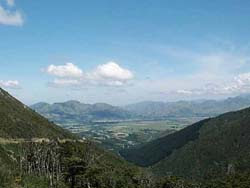
The flight from Auckland, in the north island, to Christchurch, in the south island of New Zealand, the last 464 miles, was spectacular. By now it was morning and light. It was an hour and a half flight, and as I soared above the clouds with the tingling sensation of fatigue and liberation, the snow-capped peaks of the Southern Alps came into view. These mountains were named by Franz Josef, a European, and early explorer in New Zealand. He thought they looked so much like the European Alps that he named them the southern Alps! Look at the photo of these mountains on this page – aren’t they spectacular?

As we approached Christchurch the plane crossed beautiful braided streams and fertile farmland with sheep grazing everywhere. It was quite a pastoral scene.

The pastoral scene quickly gave way to uninviting cold as we claimed our bags (those of us whose bags arrived) and trudged through sleet and hail to get to the Antarctica New Zealand Headquarters, the control station for the New Zealand program. We were told that our team member from Germany was waiting for us there. But when we arrived, drenched and freezing, we discovered that he had already left. But it was hard not to think: “Boy, if this feels cold, how on earth am I going to survive in Antarctica?”

We eventually took a shuttle bus to a very quaint Bed and Breakfast where the entire ARISE team was going to stay. We threw our bags in our rooms, and headed out to find some lunch and to explore town. By now the sun had come out and, though it was still chilly, it was no longer hailing. We met up with a woman we were working with to do Educational Outreach for Gifted and Talented students in New Zealand the following day. Struggling to stay awake, we discussed our plans and plotted the next two days. We then took a walk in Canterbury Gardens, a magnificent garden that cuts right through the city. We were reminded that, indeed, despite the hail and sleet, it is spring in Christchurch. The flowers are in full bloom, lilacs are fragrant, and ducklings are being herded everywhere by their parents.
I recalled how, the day I left Michigan, the foliage was just beginning to show bright reds and yellows to usher in the fall. What a contrast this was!

We walked to keep ourselves awake, eventually met up with other ANDRILL scientists for dinner. There was great anticipation of heading down to the ice, and I as delighted to have kindred souls to share the excitement. I even met up with a man I did work with 22 years ago on the ice: Dr. Larry Krissek. Larry is a sedimentologist from Ohio State University. I worked closely with Larry and other Ohio State geologists when I was down on the ice in 1985-86, working on my Master’s Thesis in the Central Transantarctic Mountains. Unlike me, Larry stayed involved in Antarctic geology quite consistently in these intervening years – and we were thrilled to share stories and catch up on 22 years. I was reminded that the Antarctic Research Program, despite its international presence, is quite a small community. I feel honored to be re-welcomed into that world.


After dinner and conversation, I finally permitted myself to collapse into bed at 9 pm. Having been awake for around 48 hours, it was time for sleep!

Monday, October 1, 2007

Saying Goodbye


You can anticipate goodbyes, but I must say that it is hard to prepare yourself for the hurt of saying goodbye to your family for 9 weeks! My daughters, Maia and Ivy,ages 15 and 11, and my husband, just left the airport where they bid me farewell. I’m really off now! So many changes will happen to my girls while I am gone!

But I am off to explore new horizons and to bring knowledge of a world so remote back to a cadre of eager virtual explorers. Our journey has begun, my friends! I will fly from Detroit to Dallas, Dallas to Los Angeles, Los Angeles to Auckland, New Zealand, and Auckland to Christchurch, New Zealand. I will meet up with other members of the ARISE team at various layovers along the way. It is now a Monday afternoon, and I will not arrive until Wednesday morning. (Keep in mind though, I am crossing not only the equator, but the international dateline as well!)

My dispaches will be irregular, but I will try to keep you as well posted as I can. Thanks for being a part of the journey.